

Address
Sogndal – Åfarnes
0 users have saved this item in their Bucket list.
You can also make your own list.
Route Facts
Start: Sogndal
Finish: Åfarnes
Length: Approx. 530 km
Surface: Predominantly paved roads, including narrow mountain and valley roads
TET Norway was completely revised in 2026, evolving from a mostly gravel adventure into a mix of gravel, tiny backroads and spectacular tarmac – designed to showcase the best of Norway from a motorcycle seat.
Section 7 is a journey through some of Western Norway’s most dramatic scenery. Starting beside the Sognefjord, it climbs over magnificent mountain roads before exploring the glacier valleys of Nordfjord and the spectacular landscapes of Sunnmøre and Romsdal.
There are waterfalls, hairpin bends, glaciers and fjords around almost every corner. And although the route is mainly paved, don’t expect an ordinary road trip. Some of these roads are narrow, remote and wonderfully adventurous.
Gaularfjellet – hairpins with a view
From Sogndal, the route heads towards the Sognefjord and the ferry crossing from Hella to Dragsvik. On the northern side, one of Norway’s great motorcycle roads awaits.
Norwegian Scenic Route Gaularfjellet climbs dramatically from the fjord through a spectacular series of hairpin bends. The road is narrow and twisting, with increasingly impressive views as you gain altitude.
Near the top, stop at Utsikten, an extraordinary viewing platform perched above the mountainside. Designed by Code Arkitektur, its three projecting platforms offer different perspectives of the winding road and the landscape far below.
The view is magnificent, but don’t forget to look back at the road itself. The hairpin bends climbing towards Utsikten are among the highlights of this section.
Beyond the viewpoint, the scenery changes into open mountain landscapes, rivers and waterfalls. Gaularfjellet is more than a spectacular climb. It’s a beautiful mountain crossing from beginning to end.
Through the green valleys of Sunnfjord
Leaving the high mountains behind, the route explores the valleys and smaller roads of Sunnfjord before continuing towards Nordfjord.
This part of the journey offers a welcome change of pace. Instead of dramatic mountain passes, you’ll encounter green valleys, rivers, traditional farms and peaceful rural landscapes.
The smaller roads are part of the attraction. They may not be as famous as Norway’s national scenic routes, but they offer the kind of relaxed, enjoyable riding that makes exploring Norway by motorcycle so rewarding.
Eventually, the landscape becomes increasingly dramatic as the route approaches the glaciers and towering mountains around Olden and Loen.
Briksdalsbreen – riding towards the ice
One of the great highlights of Section 7 is the detour into Oldedalen, towards Briksdalsbreen – one of the easiest accessible glaciers in Norway.
The paved road follows the valley past beautiful lakes, waterfalls and enormous mountain walls. Even without the glacier at the end, this would be a memorable motorcycle ride.
Briksdalsbreen is an arm of the mighty Jostedalsbreen glacier, the largest glacier on mainland Europe. For generations, visitors have travelled into this valley to experience the dramatic meeting between ice, mountains and green farmland.
The glacier has retreated considerably over recent decades, leaving visible traces of how the landscape has changed. From the visitor area, you can continue on foot towards the glacier viewpoint.
Motorcycles cannot reach the glacier itself, of course, but the ride through Oldedalen makes the detour worthwhile long before you reach the parking area.
Lovatnet – beautiful scenery and a tragic history
Another spectacular detour leads from Loen along Lovatnet, towards Kjenndalsbreen.
The road follows the striking turquoise lake beneath enormous mountains. Much of the route is narrow, and the final approach towards Kjenndalsbreen offers a more remote experience than the main roads through Nordfjord.
However, Lovatnet is also the setting of two of Norway’s most devastating natural disasters.
In 1905, a massive rockslide from Ramnefjellet crashed into the lake, creating enormous waves that devastated settlements along the shore. Sixty-one people lost their lives.
In 1936, another rockslide from the same mountain caused an even greater disaster, killing 74 people. The villages of Bødal and Nesdal were among the communities affected.
Today, memorials and traces of the disasters remind visitors of the tremendous forces hidden within this beautiful landscape.
At the end of the valley, Kjenndalsbreen provides another opportunity to experience the glacier scenery of Jostedalsbreen. Together, the Oldedalen and Lodalen detours make this one of the most memorable parts of Section 7.
Nordfjord – surrounded by motorcycle treasures
As the route continues through Nordfjord, you’re travelling through an area packed with some of Norway’s finest motorcycle roads and attractions.
Panoramavegen offers magnificent views across Nordfjord, while the historic mountain farm at Rakssetra is a popular destination for those willing to take a short hike.
Farther east, Scenic Route Gamle Strynefjellsvegen is another extraordinary mountain road, with gravel stretches and a history dating back to the 19th century.
These are not necessarily all part of Section 7 itself. However, they are excellent reasons to allow extra time in the region, particularly if you’re combining several TET sections or planning a longer Norwegian motorcycle adventure.
Towards Geiranger and Sunnmøre
Continuing north and east, Section 7 approaches the dramatic mountain landscapes around Geiranger.
This is another region where the roads are almost as famous as the scenery. Deep fjords, towering mountains and spectacular climbs have made the area one of Norway’s best-known motorcycle destinations.
The nearby Geiranger–Trollstigen Scenic Route is a particular highlight, combining remarkable engineering with some of the country’s most dramatic landscapes.
Depending on your plans, attractions such as Dalsnibba, 1500 meters above Geiranger, or Ørnesvingen Viewpoint on the other side of Geiranger, may also be worth a stop.
The important thing is to allow enough time. In this part of Norway, even a relatively short distance can become an all-day adventure when every viewpoint demands another stop.
If time allows it, make a quick stop along the way at Gundmundsjuvet. A gorge just by the road.
And finally, don’t miss Trollstigen, one of Norway’s most famous mountain roads. Its eleven spectacular hairpin bends climb a steep mountainside, surrounded by towering peaks and waterfalls. At the top, an architect-designed viewing platform extends above the valley, offering breathtaking views of the road twisting far below. Even if you’re not riding Trollstigen itself, the viewpoint is an attraction worth visiting.
The final stretch towards Åfarnes
The northern part of Section 7 brings the journey into the magnificent landscapes of Romsdal, where steep mountains rise above deep valleys and fjords.
This is a region famous for its dramatic scenery and extraordinary roads. Around Åndalsnes, the mountains seem to rise almost vertically from the valley floor, creating some of the most recognisable landscapes in Norway.
The route eventually reaches Åfarnes, beside Romsdalsfjorden, where Section 7 comes to an end.
After approximately 530 kilometres, you’ve experienced a remarkable variety of Western Norway: the hairpin bends of Gaularfjellet, the peaceful valleys of Sunnfjord, the glaciers of Nordfjord and the dramatic mountain landscapes farther north.
And perhaps the greatest challenge of this section isn’t the riding at all. It’s finding enough time to stop and enjoy everything along the way!
Explore TET Norway
Norway currently has 17 TET sections covering more than 9,000 kilometers. Explore them below.
👉 See all sections in one, approximate map.
Section 1: Øyermoen – Blåhø
Section 2: Dagali – Lysefjorden
Section 3: Finland – North Cape
Section 4: Lysefjorden – Utne
Section 5: Kinsarvik – Geilo
Section 6: Hol – Sogndal
Section 7: Sogndal – Åfarnes
Section 8: Åfarnes – Orkanger
Section 9: Viksdalsvatnet – Vestkapp – Geiranger
Section 10: Granvin – Vangsnes
Section 11: Kristiansand – Årdal
Section 12: Rjukan – Lunde – Dalen
Section 13: Lom – Grotli
Section 14: Orkanger – Bodø
Section 15: Moskenes – Alta
Section 16: Orkanger – Gäddede
Section 17: Bergen – Modalen

Practical information
The Trans Euro Trail is maintained by volunteers called Linesmen. Norway’s Linesman is Tore Silseth, who develops, checks and updates the Norwegian sections.
This work is particularly important in Norway. Off-road riding is generally not permitted, and many private gravel roads are closed to motorised traffic. The TET is designed to follow roads where motorcycles are legally allowed.
TET routes are constantly evolving. Roads may close, access can change, and sections may be rerouted. Always download the latest GPX file from the official Trans Euro Trail Norway website shortly before your ride.
The routes shown on Bucket List Norway are simplified illustrations, not navigation tracks. They only show the approximate location of each section and cannot be used for navigation. Bucket List Norway does not provide official TET GPX files.
Wild camping is generally permitted under Norway’s right to roam, provided you follow the rules and respect homes, farmland and nature. Campsites and other accommodation are also available along or near most sections.
For information about ferries, FerryPay, toll roads, traffic rules and other useful information for motorcycle travellers, see my General Norway Information.
Please respect gates, signs, local restrictions and other road users. Responsible riding helps keep these roads open for everyone.


Need a place to sleep in the area? 😴
Please support the site by using my affiliate link in button below if you are looking for a place to sleep in this area! It goes a long way in terms of keeping the site free!! Booking.com let you ride freely – yet find accommodation anywhere when your are done! ❤️👇

Other locations in this part of the country:

Experience the Trollstigen viewpoint and visitor center above Norway’s famous hairpins along the Scenic Route Geiranger–Trollstigen.
View more
Norwegian Scenic Route Atlanterhavsvegen runs from Kårvåg to Bud, a total distance of 36 km.
View more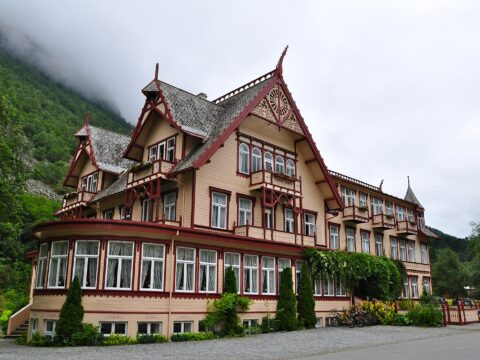
In Øye, you'll find a hotel gem from the olden times, when travelling meant introspective discovery and hiking adventures in tweed.
View more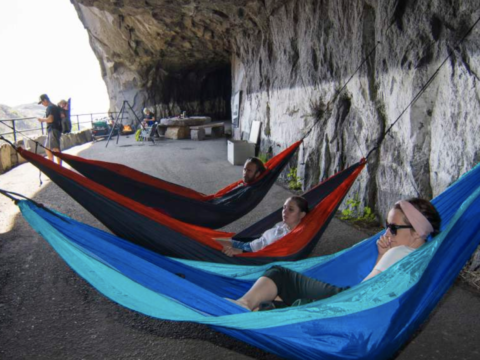
Tunnelstuo is a spectacular place to sleep in a former operative tunnel built in 1921.
View more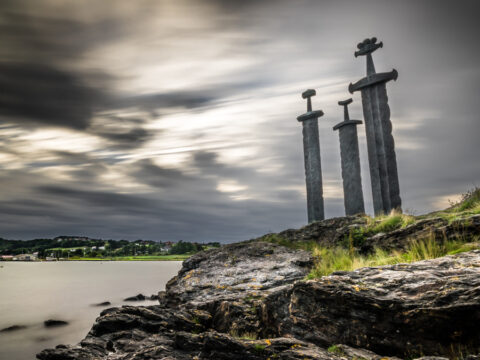
Sverd i fjell (Swords in Rock) is a huge monument located in Hafrsfjord just outside the city of Stavanger.
View more
The picturesque Fish Market in Bergen is one of Norway's most visited outdoors markets.
View more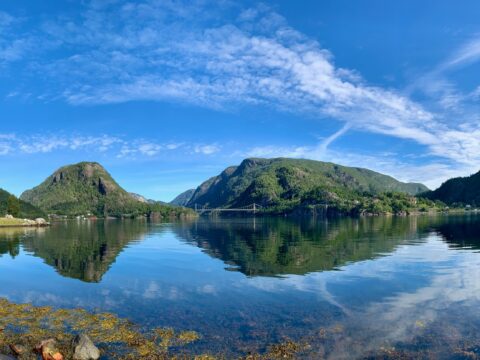
Scenic Route Ryfylke is 267 km long and travels between Oanes at Lysefjorden and Håra. From Lovra the tourist route splits in two sections.
View more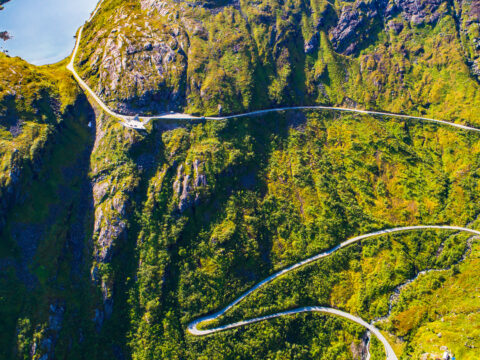
Norwegian Scenic Route Gaularfjellet runs from Balestrand to Moskog and from Sande to Eldalsosen, a total distance of 114 km.
View more