

TET Norway Section 2
Start: Dagali
Finish: Lysebotn
Length: Approx. 381 km
Surface: Mostly paved, with some gravel
TET Norway was completely revised in 2026, evolving from a mostly gravel adventure into a mix of gravel, tiny backroads and spectacular tarmac – designed to showcase the best of Norway from a motorcycle seat.
Section 2 may be the perfect example of that new philosophy.
There is relatively little gravel here. Instead, the 381-kilometer route from Dagali to Lysebotn connects one brilliant motorcycle road after another, crossing high mountain plateaus, twisting through Telemark and finishing with one of the most spectacular descents in Norway.
At some point I have ridden all of these roads, although never connected quite like this. And honestly, whoever put Section 2 together has very good taste in motorcycle roads! 🤩 (Thanks you, Tore Silseth!)
From Dagali across Imingfjell
Section 2 begins at Dagali on Rv40, one of my favourite motorcycle roads in southern Norway. (Geilo – Kongsvinger)
However, the TET only gives you a small taste of it before turning south towards Tinnsjøen. If you arrive from the east, consider exploring more of Rv40 before starting the TET.
From Dagali, the route follows Tinnvegen towards Austbygde. This is a fantastic motorcycle road. The road climbs quickly into the mountains towards Imingfjell. Tight bends gradually give way to a beautiful high mountain plateau before the road drops towards Tinn and Tinnsjøen on the other side.
There is also a dam at Sønstevatn which makes a natural stop along the way.
The combination of the climbs, mountain landscape and twisting descent makes Tinnvegen one of the first real highlights of Section 2.
There will be many more.
Through industrial history in Rjukan
The route reaches Tinnsjøen and continues towards Rjukan. Don’t rush through town.
Rjukan was built around the enormous hydroelectric and industrial development started by Norsk Hydro in the early 1900s. The town, industrial sites and transport systems are today part of the Rjukan–Notodden UNESCO World Heritage Site.
Many of the old workers’ houses and other buildings have been beautifully preserved. Simply riding slowly through town gives you a glimpse of what life here looked like during Norway’s early industrial era.
Nearby Vemork is also famous for an entirely different reason. During World War II, Norwegian resistance fighters carried out the famous heavy-water sabotage operation here.
Then it is time to climb again.
The switchbacks out of Rjukan are enormous fun on a motorcycle! They quickly lift you away from the narrow valley and back towards the open mountain landscape of Hardangervidda.
After another stretch of vidde – the Norwegian word for a wide mountain plateau – Section 2 eventually reaches the Rauland area.
Following Myllargutvegen
Around Austbø, the TET joins Myllargutvegen, another road I know well.
The route is named after legendary Norwegian fiddler Torgeir Augundsson, better known as Myllarguten. The complete Myllargutvegen runs between Nutheim and Haukeligrend through some wonderfully varied Telemark scenery.
The TET follows part of this route through a landscape of lakes, mountains, forests and small communities. It is classic Telemark motorcycle country: narrow roads, constant bends and very little reason to hurry.
Eventually Section 2 reaches Åmot. The obvious way from here would be to follow the main road towards Dalen. Naturally, the TET doesn’t do that…
Gravel, Ravnejuv and Dalen
Instead, Section 2 finds a much more interesting way towards Dalen. The route leaves the main road and follows smaller roads, including gravel, passing the gorge Ravnejuv.
And this stop is worth making.
Ravnejuv is a spectacular gorge where the cliff drops around 350 metres towards the river below. Walk the short distance from the road to the edge and you suddenly find yourself staring into an enormous hole in the landscape.
Be careful. There isn’t much between you and a very long way down.
From Ravnejuv, the TET continues towards Dalen. And Dalen deserves some time. The extraordinary Dalen Hotel looks almost like something from a Norwegian fairy tale. Opened in 1894, the huge wooden hotel is one of the most distinctive historic hotels in Norway.
Dalen is also the western end of the Telemark Canal, where the canal boats finish their long journey through locks, lakes and waterways from the sea in the Skien area.
Have a coffee. Walk around. Take some pictures. Because the route is about to become very interesting again.
Around Bandak – because the direct road would be too easy
Instead of simply continuing west, Section 2 makes a strange-looking loop along Bandak. Look at the map and you may wonder why. The answer appears to be exactly what you would hope for: better roads.
Small roads climb away from the lake through tight bends and dramatic terrain. Parts of the road network around Bandak are narrow and gravelled, while other sections contain some excellent old-fashioned serpentines.
It is a perfect example of the philosophy behind the new TET Norway. The fastest road isn’t necessarily the best road.
Eventually the route turns west again and joins Fv450.
And from here, Section 2 saves some of its very best riding until last.
Suleskarvegen
The TET now joins Suleskarvegen, one of southern Norway’s great mountain roads.
The road climbs through increasingly wild high-mountain terrain between Setesdal and Sirdal. It is narrow in places, wonderfully twisty and surrounded by lakes, bare mountains and enormous open landscapes.
Suleskarvegen is a seasonal road and normally closes during winter. Even after opening, conditions in the mountains can change quickly.
For motorcyclists, though, this road is difficult not to love.
But Section 2 still has one final trick waiting.
Lysevegen – save the best for last
Eventually the TET turns onto Lysevegen towards Lysebotn.
This is one of my favourite motorcycle roads in Norway – and one of those roads that hardly seems possible when you see where it goes. First, Lysevegen crosses a barren mountain landscape almost 1,000 meters above sea level – pure joy and fantastic views!
Then you reach Øygardstøl, also known as the Eagle’s Nest and the starting point for the famous hike to Kjerag/Kjeragbolten (the Kjerag boulder).
Stop here. Because below you is Lysebotn.
And between you and the fjord are 27 hairpin bends (Lysebotn stiga (Lysebotn ladder)), more than 900 meters of elevation difference and even a corkscrew tunnel inside the mountain! 🤩
Then down you go.
Hairpin after hairpin drops you towards the bottom of the valley until you finally reach Lysebotn and the end of Lysefjorden.
After 381 kilometres of mountain roads, industrial history, tiny Telemark backroads, gravel, high plateaus and some seriously entertaining bends, it is difficult to imagine a better finish.
Section 2 isn’t traditional TET – there isn’t enough gravel for that.
But if the purpose of the new TET Norway is to show visiting motorcyclists some of the best riding this country has to offer, Section 2 absolutely nails it. 🥳
Explore TET Norway
Norway currently has 17 TET sections covering more than 9,000 kilometers. Explore them below.
👉 See all sections in one, approximate map.
Section 1: Øyermoen – Blåhø
Section 2: Dagali – Lysefjorden
Section 3: Finland – North Cape
Section 4: Lysefjorden – Utne
Section 5: Kinsarvik – Geilo
Section 6: Hol – Sogndal
Section 7: Sogndal – Åfarnes
Section 8: Åfarnes – Orkanger
Section 9: Viksdalsvatnet – Vestkapp – Geiranger
Section 10: Granvin – Vangsnes
Section 11: Kristiansand – Årdal
Section 12: Rjukan – Lunde – Dalen
Section 13: Lom – Grotli
Section 14: Orkanger – Bodø
Section 15: Moskenes – Alta
Section 16: Orkanger – Gäddede
Section 17: Bergen – Modalen

Practical information
The Trans Euro Trail is maintained by volunteers called Linesmen. Norway’s Linesman is Tore Silseth, who develops, checks and updates the Norwegian sections.
This work is particularly important in Norway. Off-road riding is generally not permitted, and many private gravel roads are closed to motorised traffic. The TET is designed to follow roads where motorcycles are legally allowed.
TET routes are constantly evolving. Roads may close, access can change, and sections may be rerouted. Always download the latest GPX file from the official Trans Euro Trail Norway website shortly before your ride.
The routes shown on Bucket List Norway are simplified illustrations, not navigation tracks. They only show the approximate location of each section and cannot be used for navigation. Bucket List Norway does not provide official TET GPX files.
Wild camping is generally permitted under Norway’s right to roam, provided you follow the rules and respect homes, farmland and nature. Campsites and other accommodation are also available along or near most sections.
For information about ferries, FerryPay, toll roads, traffic rules and other useful information for motorcycle travellers, see my General Norway Information.
Please respect gates, signs, local restrictions and other road users. Responsible riding helps keep these roads open for everyone.
YouTube Shorts by FiGu.
YouTube video by Tomasz Korzeniowski.


Need a place to sleep in the area? 😴
Please support the site by using my affiliate link in button below if you are looking for a place to sleep in this area! It goes a long way in terms of keeping the site free!! Booking.com let you ride freely – yet find accommodation anywhere when your are done! ❤️👇

Other locations in this part of the country:

The mountain Gaustatoppen (1883 masl.) is by many considered the most beautiful mountain in Norway. And it holds a secret…
View more
Ride to Ravnjuvet in Telemark and stand above a wild gorge once visited by royalty and rebels.
View more
Allmannajuvet ("common-man's-gorge") is a preserved zinc mine museum near Sauda that was operational for 18 years between 1881 and 1899.
View more
Ride TET Norway Section 4 from Lysefjorden to Utne – 502 km of spectacular mountain passes, waterfalls and winding fjord roads.
View more
Over the mountain between Hemsedal and Ål is a beautiful gravel road called Fanitullvegen. The road is a tollroad, so remember to bring cash.
View more
Visit EAC Bilhistorisk Senter near Oslo and discover one of the world's finest collections of rare American classic cars.
View more
Tindevegen, 'The High Peaks Road', is a mountain road through Jotunheimen between Turtagrø and Øvre Årdal — 32 km long — all on tarmac.
View more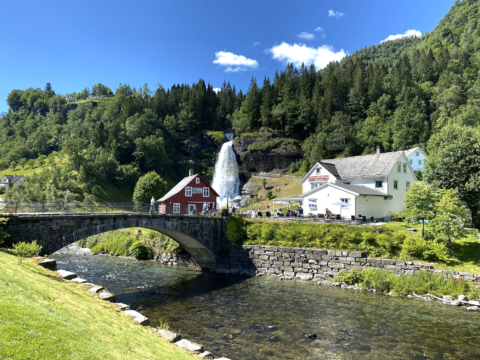
At the fantastic Steindalsfossen, visitors can walk behind the waterfall without getting wet. Just 2 km from Scenic Route Hardanger!
View more